 COME
COMECOME daily bonus claim days are not a monthly rate
COME daily bonus rows state a number of claim days. Do not extend a three-day or five-day row across a month without an actual programme rule that supports it.
Read the stated duration
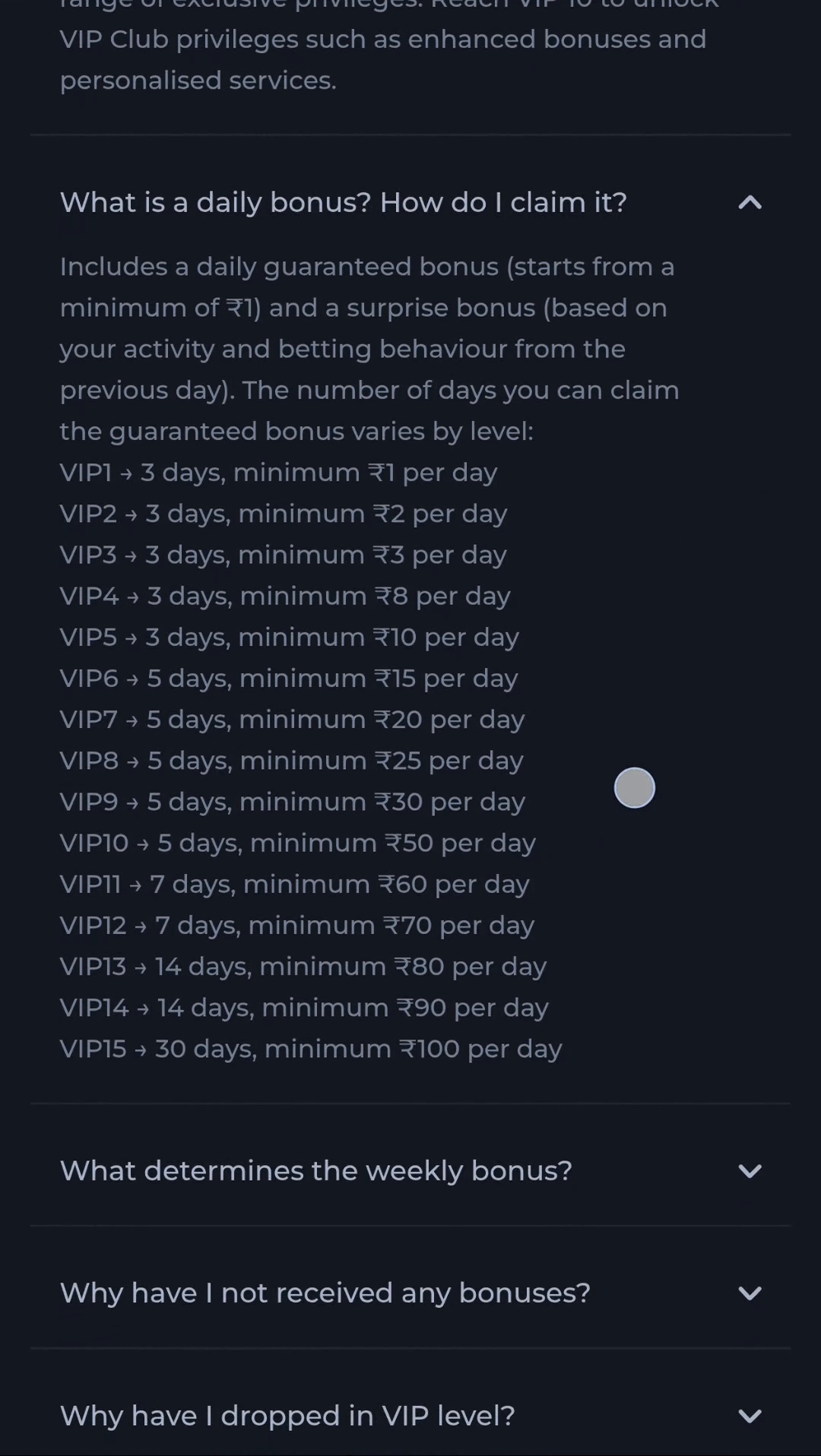
VIP1 through VIP5 list three claim days, while VIP6 through VIP10 list five. Higher levels show other durations. The table describes those periods alongside daily minima; a daily label alone is not a promise of an indefinitely recurring payment.
Do not extend a short row by assumption
For example, VIP4 lists ₹8 minimum per day for three days. The arithmetic over that period is ₹24 if all applicable claims qualify. Multiplying ₹8 by 30 would describe an invented thirty-day period for that row, not the stated offer.
Keep claim rules and level changes explicit
Read the current level and applicable claim status within the service. Do not assume the period restarts after an update, a reinstall or a new visit. A software change is not a reward-policy change, and the table gives no such reset rule.
Use programme records for a missing day
For an account-specific question, retain the row, date and message. The recognised help route can address that record. Avoid trying repeated account changes or extra activity merely to make the arithmetic fit an assumed calendar month.
A practical example
A five-day VIP row can span dates that fall in two calendar months. The month boundary alone does not rewrite the row as two awards or establish a restart. The programme period, rather than a calendar assumption, is the relevant unit.
What a completed answer looks like
You can explain the daily amount over its stated claim period without turning the programme into an unsupported monthly-income promise.
Choose another specific COME guide